




Engineering teams often reach a point where managing design files alone is no longer enough. Autodesk Vault Professional® is an excellent platform for controlling CAD data, managing revisions, and keeping engineering teams organized. But as products, processes, and stakeholders grow more complex, many organizations begin asking a broader question: Do we need something more than PDM?
That’s where Autodesk Vault PLM enters the conversation.
While Vault Professional focuses on product data management (PDM), Vault PLM extends those capabilities to support product lifecycle management (PLM). Vault Pro is not replaced with Vault PLM. Instead, Vault PLM builds on Vault Professional to expand beyond engineering into other parts of the organization.
Understanding when Vault Professional is sufficient—and when Vault PLM becomes valuable—can help organizations make the right investment in their data strategy.
Where Vault Professional Excels
Vault Professional is designed to help engineering teams manage design data efficiently and reliably. It provides robust tools for controlling files, revisions, and collaboration around CAD models and drawings.
With Vault Professional, teams can:
- Manage design files from tools like Autodesk Inventor®, AutoCAD®, and other engineering software
- Track revisions and maintain a complete design history
- Control access and permissions for engineering data
- Automate common tasks using lifecycle states and change orders
- Reuse design data more effectively
For many organizations, particularly small to mid-sized engineering teams, these capabilities are exactly what’s needed. If most of your workflows revolve around CAD files and engineering-driven processes, Vault Professional often provides the right level of control without unnecessary complexity.
In short, Vault Professional is ideal when your primary goal is managing engineering data.
Signs Vault Professional May Be Enough
Many companies operate successfully for years with Vault Professional alone. If the following statements describe your environment, Vault Professional is likely the right fit:
- Engineering owns most product data processes
- Change management happens primarily within the engineering team
- Bills of materials (BOMs) are managed within CAD tools
- Other departments reference engineering data but do not actively participate in structured workflows
- ERP or other business systems are managed separately
In these situations, Vault Professional provides the necessary structure and control for engineering teams without introducing additional process layers.
However, as organizations scale, the way product data moves through the company often becomes more complex.
When the Limits of PDM Begin to Appear
As products become more sophisticated and organizations grow, more departments need direct participation in the creation and maintenance of product data. Procurement, manufacturing, quality, and management teams all need visibility into product information.
This is where traditional PDM workflows can begin to feel limiting.
Some common signs include:
- BOMs must be shared and approved across multiple departments
- Change processes involve manufacturing, sourcing, or quality teams
- Product information lives in spreadsheets, emails, or disconnected systems
- ERP integration becomes increasingly important
- Leadership needs visibility into product lifecycle status
When these challenges emerge, the issue is rarely the engineering data itself. Instead, the challenge lies in managing the broader lifecycle of the product across the organization.
This is the point where PLM becomes valuable.
What Vault PLM Adds
Vault PLM builds on the foundation of Vault Professional by extending product data workflows beyond engineering into the rest of the business.
While Vault Professional focuses on files, Vault PLM focuses on structured product information and business processes.
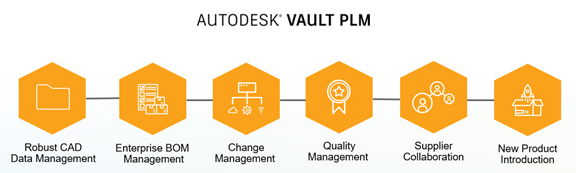
With Vault PLM, organizations can:
- Manage item masters and structured product records
- Coordinate change processes across multiple departments
- Connect engineering with ERP and business systems
- Track product lifecycle stages from concept through production
- Provide non‑CAD users access to product data through web interfaces
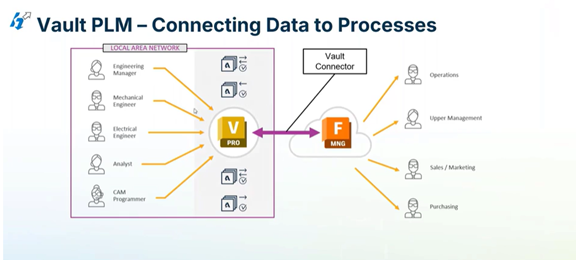
In practical terms, Vault PLM allows product data to move from an engineering tool into a company-wide information system.
Instead of relying on spreadsheets, emails, or manual processes, organizations gain a structured way to manage product information across the entire lifecycle.
Vault Professional and Vault PLM Work Together
It’s important to understand that Vault PLM does not replace Vault Professional. Rather, the two systems work together.
Vault Professional continues to manage CAD files and engineering workflows, while Vault PLM manages items, lifecycle processes, and cross-department collaboration.
This combination allows engineering teams to maintain their familiar design environment while enabling the rest of the organization to participate in structured product workflows.
Choosing the Right Step Forward
Deciding whether Vault Professional is enough—or whether Vault PLM is the next step—ultimately depends on how your organization manages product information.
If your needs center around CAD data control, revision management, and engineering collaboration, Vault Professional is often the perfect solution.
But if product data must flow across departments, integrate with business systems, and support structured lifecycle processes, Vault PLM provides the additional framework needed to manage that complexity.
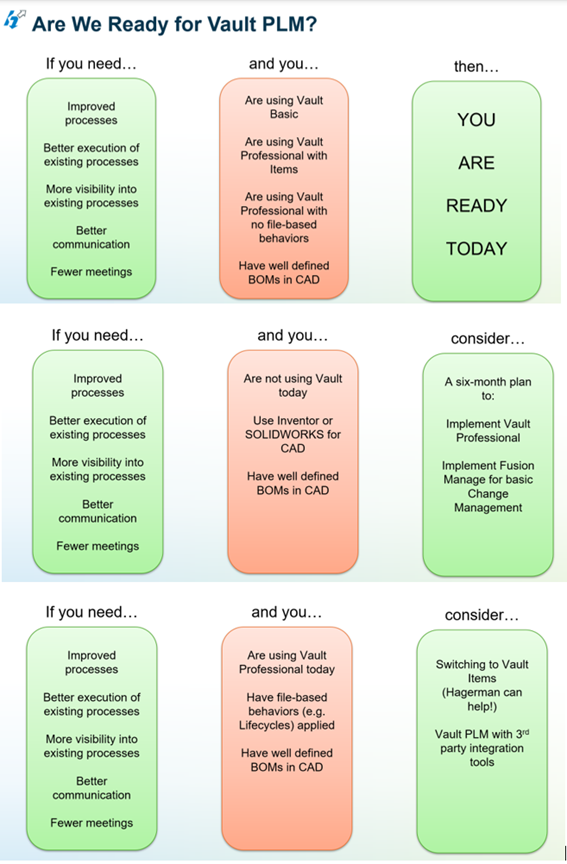
Many organizations begin their data management journey with Vault Professional and expand into PLM as their products, teams, and processes evolve.
The key is recognizing when engineering data has become business-critical information that must move beyond the engineering department.
When that shift occurs, Vault PLM can transform product data from a set of design files into a structured system that supports the entire organization.
Learn More
If you’re evaluating Autodesk Vault solutions or considering whether PLM is the next step for your organization, Hagerman & Company can help. Our team works with engineering and manufacturing organizations to design data management strategies that scale with growth.





Comments